
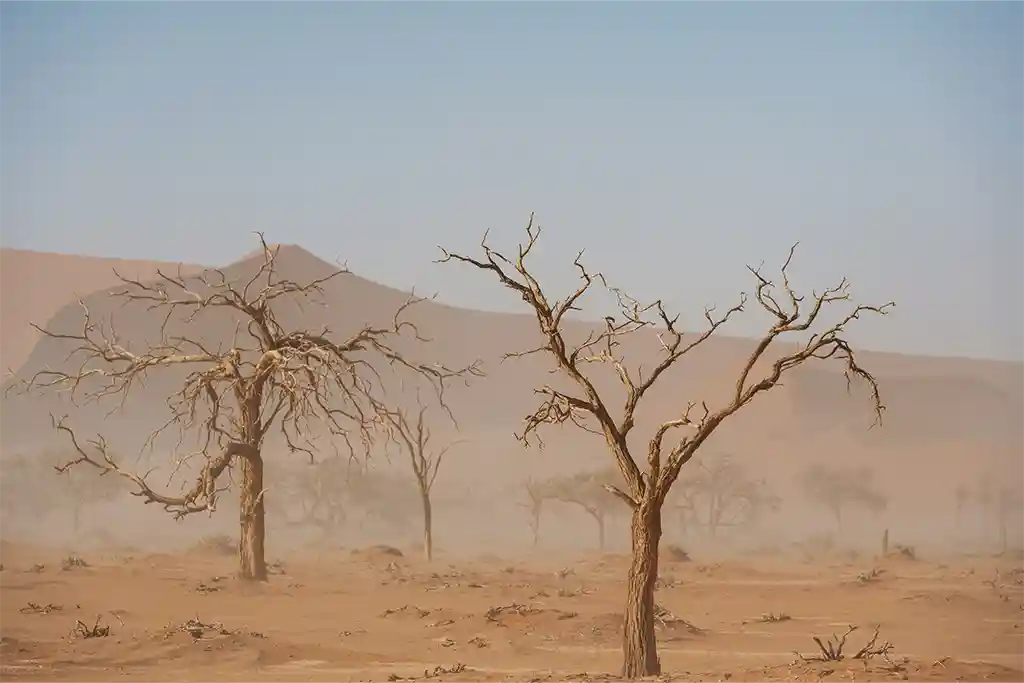
Paragraph 33 of the 2030 Agenda explains how managing the Earth’s natural resources well supports social and economic development. It also emphasizes working together on issues like desertification, dust storms, land degradation, drought, resilience building, and disaster risk reduction.
Sustainable Development Goal 15 (Life on Land) aims to protect and restore terrestrial ecosystems, manage forests sustainably, fight desertification, stop land degradation, and preserve biodiversity.
In the Future We Want document (Rio+20), paragraph 205 highlights the economic and social importance of healthy land and soil. Countries voiced concerns about desertification, land degradation, and drought especially in Africa, Least Developed Countries (LDCs), and Landlocked Developing Countries (LLDCs). They called for action at national, regional, and global levels to reverse land degradation, mobilize funding from both public and private sources, and implement the United Nations Convention to Combat Desertification (UNCCD) and its 10-Year Strategic Plan (2008–2018).
Paragraphs 207 and 208 of Future We Want emphasize the importance of partnerships and initiatives to safeguard land. They call for developing inclusive scientific methods and indicators to monitor and assess desertification, land degradation, and drought. They also support strengthening scientific research under the UNCCD.
The Commission on Sustainable Development (CSD) discussed combating desertification and drought in multiple sessions. In 2008 and 2009 (CSD 16–17), they examined these challenges along with land, agriculture, rural development, and Africa. In 2000 (CSD-8), they reviewed integrated land resource planning. In decision 8/3, the CSD called for holistic approaches—like ecosystem management—to tackle desertification, drought, sustainable mountain development, land degradation, coastal zones, deforestation, climate change, land use in urban and rural areas, and biodiversity conservation.
Chapters 10–13 and 15 of Agenda 21, which cover land, desertification, forests, biodiversity, and mountains, were examined in CSD-3 (1995) and again in the 1997 review.
The UN Conference on Environment and Development (UNCED) asked the UN General Assembly to form an Intergovernmental Negotiating Committee (INCD) to draft an international convention against desertification by mid-1994. The convention was adopted in Paris on 17 June 1994, opened for signature on 14–15 October 1994, and came into force on 26 December 1996.
Deserts are categorized as “fragile ecosystems” in Chapter 12 of Agenda 21. Desertification is land degradation in arid, semi-arid, and dry sub-humid areas caused by climate change or human activities. It affects about one-sixth of the global population, seventy percent of drylands, and a quarter of total land area. Desertification leads to poverty and harms billions of hectares of rangeland and cropland.
Chapter 10 of Agenda 21 covers the integrated planning and management of land resources. It stresses coordinating decisions across sectors for sustainable use of soils, minerals, water, and living organisms. This integrated view underpins Agenda 21 and the CSD’s approach to land.
As human needs and economic activity grow, pressure on land resources increases. Using land wisely by examining its various uses together reduces conflict, achieves better trade-offs, and links development with environmental protection. This integrated strategy fulfills the goals of sustainable development (Agenda 21, para 10.1). The Food and Agriculture Organization (FAO) leads work on Chapter 10 of Agenda 21.
17 SDG Malaysia is actively supporting these efforts. As an organization committed to the SDGs, it helps promote sustainable land management and works with partners to strengthen policies and practices aligned with UN conventions and global agreements.